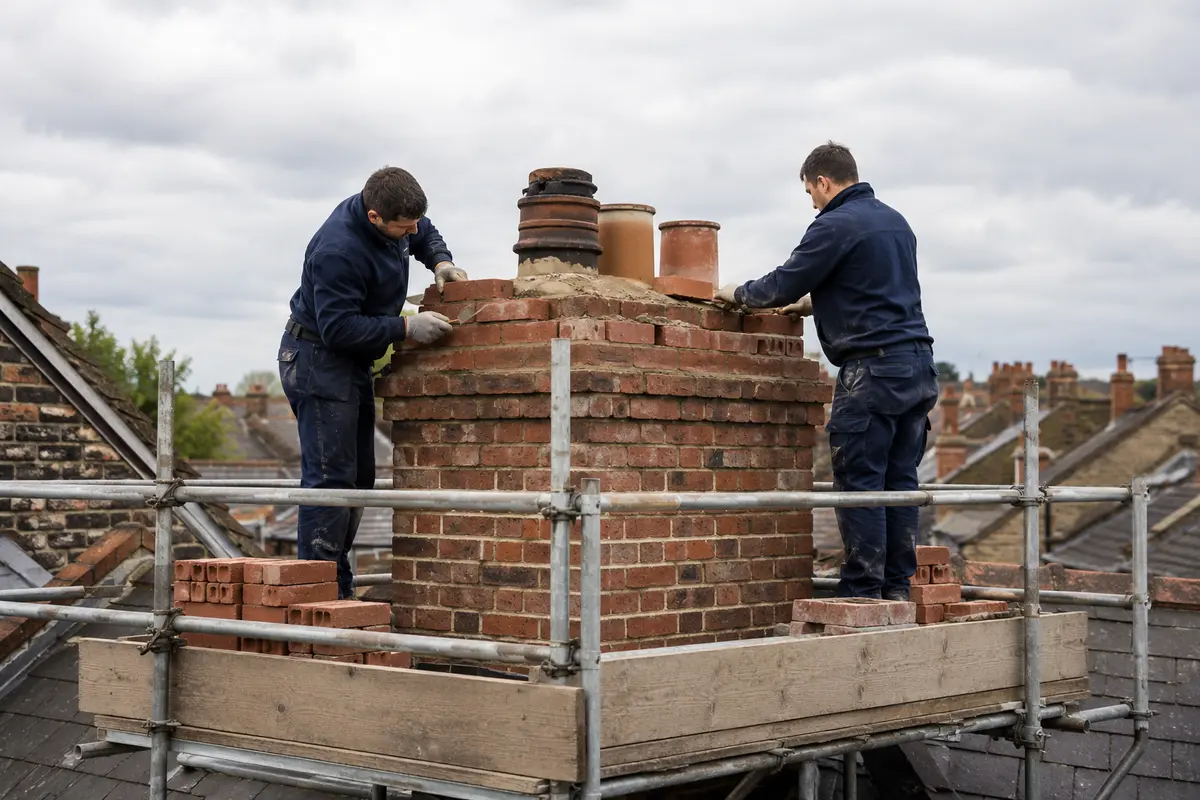
Repair or rebuild?
A rebuild is not automatically required because a chimney looks old. Repointing and local brick replacement can preserve a stable stack. Rebuilding becomes more appropriate where failure is widespread, the upper courses have separated, cracks pass through masonry, the stack leans or individual components cannot be safely retained.
Partial chimney rebuilding
The top of a stack often deteriorates first because it receives the greatest weather exposure. If the lower masonry remains sound, the unsafe upper section may be carefully dismantled to a stable course and reconstructed. Pots can be retained where suitable, or replaced as part of the work. New flaunching is then formed to shed water from the top.
Full stack rebuilding
Where instability or deterioration extends farther down, a larger rebuild may be needed. The agreed level of dismantling should be stated before work begins. The rebuilt stack should follow the original dimensions unless an approved alteration is intended, use appropriate bricks and mortar, and reconnect correctly with the roof weathering details.
What the process involves
- Assess stability, cracking, brick condition, pots and adjacent roof details.
- Plan scaffold or other safe access and protect roof coverings.
- Record dimensions and the arrangement of pots and features.
- Dismantle unstable masonry in a controlled sequence.
- Rebuild with suitable materials and bonded brickwork.
- Complete flaunching, pointing and any required flashing interface.
Material matching
Matching does not mean colour alone. Brick dimensions, porosity, texture and strength affect the result. Mortar must also work with the existing construction. On traditional buildings, a very hard cement-rich repair can behave differently from older, softer masonry.
Shared stacks and permissions
Many London chimney stacks are shared across a party wall. Ownership, access and the impact on adjoining flues should be understood before alteration. Listed buildings, conservation areas and changes to chimney height or appearance may need specialist or local-authority advice. The Planning Portal provides a useful starting point, but project-specific checks remain important.
Safety and temporary risk
If masonry is falling or the stack appears unstable, keep people and vehicles away from the area below. Do not climb onto the roof. The UK HSE roof-work guidance emphasises planned fall protection and safe access even for short tasks.