What counts as a repair?
A repair retains most of the existing stack and addresses defined defects. Examples include repointing failed joints, replacing several bricks, renewing flaunching, resetting a pot or correcting local weathering.
What counts as a rebuild?
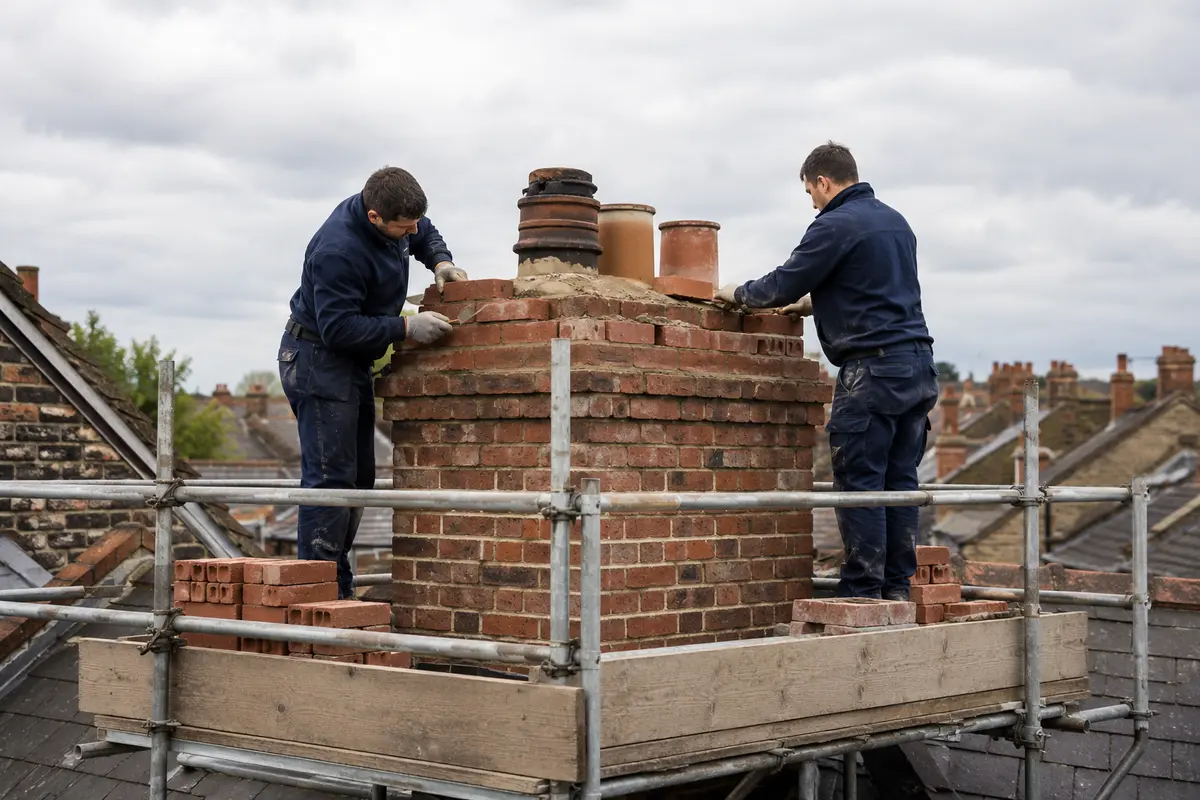
A rebuild dismantles and reconstructs a section or the whole visible stack. Partial rebuilding is common where deterioration is concentrated at the top. A full rebuild may be considered when instability or failure extends through most courses.
| Observed condition | Repair may suit | Rebuild may suit |
|---|---|---|
| Open mortar, sound bricks | Often | Usually unnecessary |
| A few damaged bricks | Often | If surrounding masonry is loose |
| Cracked flaunching | Often | If upper courses are unstable |
| Leaning or separating stack | Rarely as an isolated patch | Likely to require broader assessment |
| Widespread loose brickwork | Limited value | Often more appropriate |
Avoid choosing by price alone
A small patch is poor value if it leaves unstable masonry untouched. Equally, rebuilding sound brickwork is unnecessary disruption. Compare scopes, access, material assumptions and the evidence for each recommendation—not only the bottom-line number.
Partial rebuilding as the middle option
If lower courses are stable, dismantling only the failed upper section can retain more original fabric while resolving the unsafe portion. The transition course, brick bonding, mortar and top details must be planned carefully.
Questions to ask
- Which defects make repair or rebuilding necessary?
- How much original masonry will remain?
- Are bricks and pots being retained or replaced?
- Does the scope include flaunching and flashing interfaces?
- What access is included?
- Will before-and-after photographs be provided?